Implement
Private Institutions: Enter Purchasing Commitments
- Private Institution
- Self-Operated
Buying Directly from Values-Based Vendors: Forward Purchasing Commitments
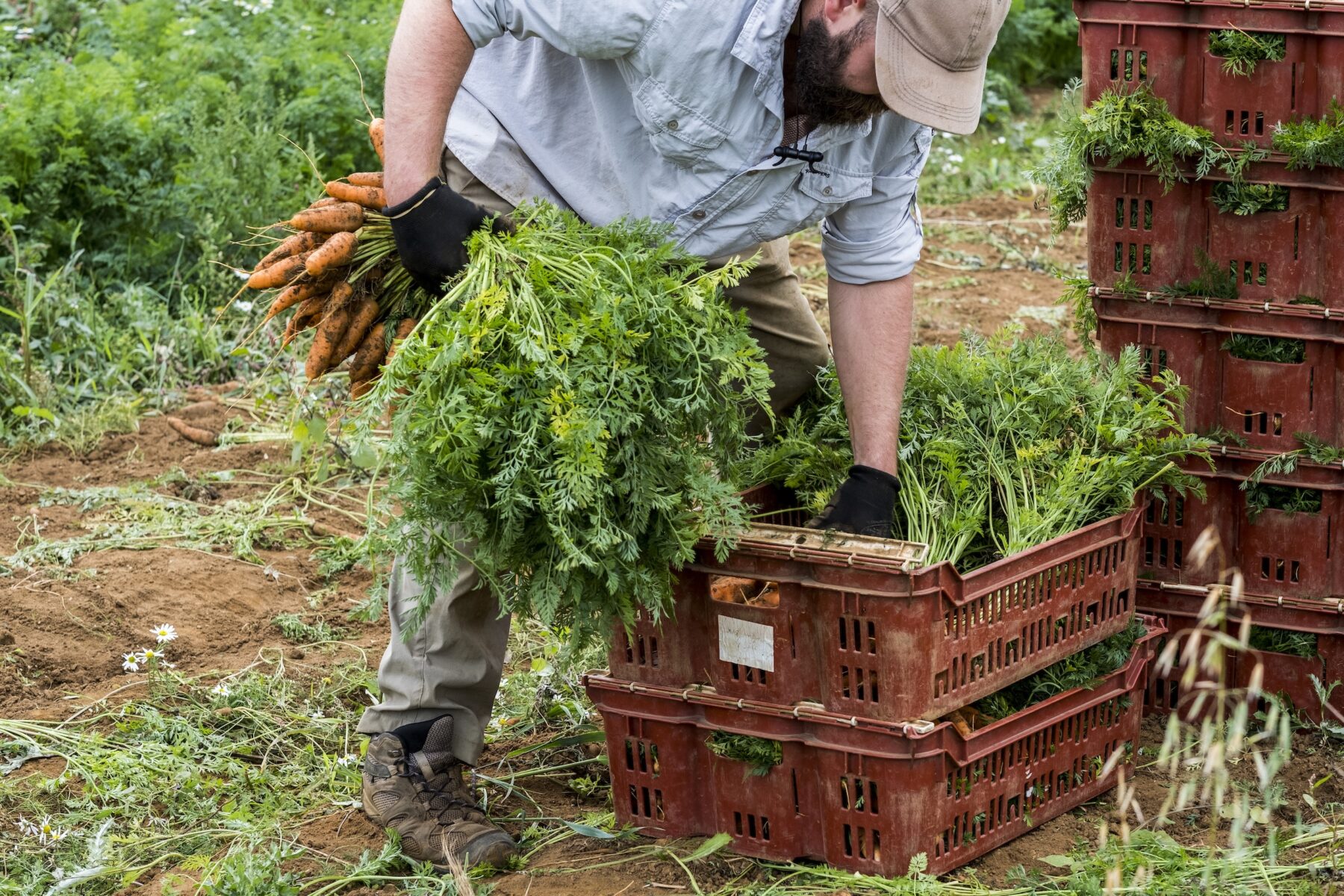
As vendor-institution relationships grow, the parties may want to form a forward purchasing commitment, in which an institution agrees in advance to purchase products over a longer period (e.g., a year or growing season). [17] These commitments can be used for many different products, and can be made with all vendor types, including farmers and food hubs. Like standing purchase orders, they involve consistent, long-term purchasing, but they require earlier coordination to help shape production plans.
Successful forward commitments depend on clear communication, collaborative planning, feasible payment terms, and mutual trust. A forward commitment allows a farmer to plan their production cycle around the commitment, and a commitment with a food hub enables coordination with its vendors to ensure that enough product is sourced to meet the commitment requirements.
These agreements may be informal or set out in a formal contract. This Toolkit recommends informal commitments because they provide flexibility. Parties can be wary of binding contracts for fear of being locked into a deal that no longer benefits them or bound to obligations they can no longer meet. Still, contracts offer greater certainty, but they must also comply with existing food service or distributor agreements.
Forward purchasing commitments give vendors predictable demand, which can support capacity increases, boost sales, and help secure loans.[18] This is particularly useful for vendors new to selling in institutional markets, which can be inconsistent and difficult to navigate. Institutions benefit from a reliable supply of values-based products and progress toward procurement goals.
Because forward commitments require significant planning and coordination, they are best pursued within strong, established relationships where both parties understand their long-term capacity and obligations.
Note:
Forward purchasing commitments are easiest to establish through informal procurement. Accordingly, the recommendations here assume that no formal solicitation is issued to find a vendor. However, forward commitments are still possible when using formal solicitations. See Values-Based Purchasing When a Formal Solicitation is Required for more.
Model Recommendations & Language
Throughout these model recommendations, the term “Vendor” refers to a producer or food hub.
An institution’s process for establishing forward purchasing commitments should involve the following steps:
- Identify a vendor where trust in the purchasing relationship has built over time.
- Determine which products are viable for a forward purchasing commitment.
- Establish a forward purchasing commitment with the vendor.
- Continue active conversations to evaluate the forward purchasing commitment.
The following recommendations focus on each step and provide model language and alternatives for incorporating the key values-based procurement features into a forward purchasing commitment. Throughout these model recommendations, the term “Vendor” refers to a producer or food hub.
Identify a Vendor Where Trust in the Purchasing Relationship has Built Over Time
Before jumping into a forward purchasing commitment, an institution must first identify a vendor with whom it has a strong working relationship. Forward commitments require the institution to guarantee future purchases, and the vendor to plan production around this commitment. It marks a shared investment and shared risk. Therefore, an existing relationship with established trust is a key foundation for forward purchasing commitments.
Individual purchase orders and standing purchase orders provide opportunities to build that trust, demonstrate reliability, and establish accountability before moving to a forward commitment.
Model Recommendation
[Institution] will assess its vendor network and determine viable candidates for a forward purchasing commitment. Through its forward purchasing, [Institution] seeks to further its values-based procurement goals and increase its investment in values-based vendors.
Potential candidates are vendors that:
- [Institution] has purchased from with consistency and frequency;
- [Institution] has a good working relationship with;
- Understand the [Institution’s] purchasing and delivery requirements; and
- Are interested in production collaboration with [Institution].
Alternative: Vendor-Initiated Forward Purchasing Commitment Proposals
Vendors may also initiate conversations about a forward purchasing commitment, especially after the vendor has completed several successful standing orders with an institution, and the vendor is prepared to cater more directly to that institution’s product needs. When the vendor proposes a forward purchasing commitment, it is important that the institution fully understands the increased commitment, planning, and risk involved.
Determine Which Products are Viable for a Forward Purchasing Commitment
To establish a forward purchasing commitment, an institution and vendor must discuss the institution’s product needs, the vendor’s production capacity, and the estimated cost. This requires collaborative planning: the vendor may adjust production (or sourcing, if a food hub), and the institution may adjust menu plans to incorporate the product.
Because the vendor will produce or source a product specifically for the institution, the institution should identify the products it needs in a steady supply. To determine what products best fit these criteria, the institution should review its food purchasing history, consumption patterns, and staff input.
At the same time, the vendor should assess its production plan, capacity, inventory, and the level of investment needed from the institution to allocate product specifically for the institution. The vendor should also consider any commitments it has to other buyers.
Model Recommendation
Institution Internal Assessment
[Institution] should compile the following information from [insert food service personnel] to determine potential products for a forward purchasing commitment:
- What products are consistently purchased?
- How much of a [insert product] is used in [specified time frame]?
- What is the price range for [insert product] over [specified time frame]?
- What products are consistently purchased that could be substituted with a similar values-based option?
- With strategic menu planning, which values-based products could the institution consistently purchase?
- Are there periods of time where the [Institution] will have reduced or no need for the product?
- Can [Institution] offer an advance payment to [Vendor]?
- What delivery requirements would apply?
[Institution] will provide [Vendor] with a list of desired products and quality, estimated quantity, price range, and commitment time period for a possible forward purchasing commitment. If an advance payment is an option, [Institution] will inform [Vendor].
Vendor Internal Assessment
Based on the information provided by [Institution], [Vendor] will determine which of [Institution’s] proposed products may be suitable for a forward purchasing commitment based on its experience, past production or inventory, and anticipated capacity.
[Vendor] will assess [Institution’s] proposed price range and volume and respond with the price range and volume they may be able to accommodate. [Vendor] may also consider whether advance payment or other investment from [Institution] may be necessary to enter into a forward purchasing commitment.
Based on [Institution’s] desired products, [Vendor] will provide [Institution] with a list of potential products, forecasted volume, price range, and time period for a forward purchasing commitment.
Vendor & Institution Planning
[Institution] and [Vendor] will continue to discuss and negotiate to determine the product(s), amount, price range, total cost, and duration of the forward purchasing commitment.
Alternative: Vendor-Led Discussions
Forward purchasing commitment discussions can also be led by the vendor. In this case, the vendor would provide the institution with a list of potential products, anticipated amounts, price range, and an appropriate time period for a forward purchasing commitment.
Option for Vendor-Led Discussions:
[Vendor] will review current production schedules for products and create a chart listing all products, their availability, and price range for a possible forward purchasing commitment. Vendor will also assess whether advance payment or other investment from [Institution] may be needed to engage in a forward purchasing commitment.
[Institution] will review [Vendor’s] proposal with its [insert food personnel] to assess feasibility.
[Institution] and [Vendor] will continue to discuss and negotiate to determine the product(s), amount, price range, total cost, and duration of forward purchasing commitment.
Establish Forward Purchasing Commitment with Vendor
Once initial discussions between the institution and vendor are complete, the parties can establish a forward purchasing commitment. As mentioned, this commitment involves the institution purchasing product(s) that the vendor produces specifically for the institution. This commitment will extend for a significant amount of time—often for an entire year or multiple growing seasons.
This template is just one way of establishing a forward purchasing commitment. It provides a reference and starting point for parties that can be used to inform and guide their specific process.
Forward purchasing commitments should incorporate the following:
- Administrative Components
- Commitment Tracking Number
- Date
- Contact Information (for both the institution and the values-based vendor)
- Authorized Signatures
- Commitment Components
- General Commitment Statement
- Products, Quality & Pricing
- Commitment Duration
- Payment Terms
- Delivery Terms
- Cancelation Policy
- Other Terms & Conditions
More details and model recommendations for each commitment component is included below. A complete forward purchasing commitment template is also available.
General Commitment Statement
A forward purchasing commitment should recognize the agreed-upon production collaboration between the vendor and institution.
Model Recommendation
[Vendor] will produce [insert product] for [Institution] from [insert duration of commitment]. [Institution] is committed to purchasing [insert product] as set forth in this commitment form.
Duration of commitment options include:
- [Start date] to [end date];
- [X number] of months;
- [Fall/Spring/Summer] semester[s];
- [X] quarter[s];
- [Fall/Winter/Spring/Summer] production season[s]; or
- [X] years.
Product, Quality & Pricing
A forward purchasing commitment should contain the total amount committed to, the product, and unit pricing parameters.
Model Recommendation
[Institution] will purchase a total of [insert total dollar amount] of [insert product and quality] from [Vendor]. Individual pricing of product(s) will adhere to the following:
- [Insert pricing per unit amount/range/standard for each product included]
Unit pricing options include:
- An agreed-upon set price or price range per product applied across all installments of the commitment.
- Current market price at time of each installment of the commitment.
- Resources for market price include USDA Market News and Agricultural Marketing Resource Center (AgMRC).
- Percentage range allowed from the current market price at the time of each installment of the commitment (with or without a minimum and maximum set price).
Example:
ABC University will purchase a total of $15,000 of broccoli (U.S. No. 1 or No. 2) from EIO Farm. Individual pricing of product(s) will adhere to the following:
- Example Pricing Options:
- Broccoli at $2.75 per pound.
- Broccoli at market price per pound set by USDA Market News on the day of delivery.
- Broccoli within a 3.5% deviation from the market price per pound set by USDA Market News on the day of delivery. Price per pound will not exceed $3.00.
The breakdown can also be conveyed in a chart:
| Product | Quality & Description | Pricing Per Unit |
| Broccoli | U.S. No. 1 or No. 2 | $2.75 per pound |
| Broccoli | U.S. No. 1 or No. 2 | Market price per pound set by USDA Market News on day of delivery. |
| Broccoli | U.S. No. 1 or No. 2 | Within 3.5% deviation from USDA Market News market price per pound on day of delivery. Price per unit will not exceed $3.00. |
Alternative: Amount by Quantity
The model recommendation provides a set dollar amount that the institution commits to purchasing from the vendor. However, an institution may instead specify a numerical product quantity. This is typically measured via weight or package method (e.g., case, bushel, box, flat). For forward purchasing commitments, the quantity may also be defined as a proportion of production, which may be the entirety (“all”) or a percentage.
Option for Indicating Amount by Quantity:
[Institution] will purchase an estimated total of [insert weight/quantity amount] of [insert product and quality] from [Vendor]. Individual pricing of product(s) will adhere to the following:
- [Insert pricing per unit amount/range/standard for each product included]
Example:
Alpha Hospital will purchase an estimated total of 4,000 pounds of broccoli (U.S. No. 1 or No. 2) from Omega Food Hub. Pricing per unit of product will adhere to the following:
- $2.75 per pound
- Broccoli at market price per pound set by USDA Market News on day of delivery.
- Broccoli within a 3.5% deviation from market price per pound set by USDA Market News on day of delivery. Price per pound will not exceed $3.00.
This information can also be conveyed in a chart: See the tables below.
| Product | Quality & Description | Weight/Quantity | Unit Amount | Pricing Per Unit |
|---|---|---|---|---|
| [Insert product number if available or name of product] | [Insert quality and any additional description] | [Insert set weight/package unit quantity] | [Insert number of units] | [Insert set price/range/standard] |
| Product | Quality & Description | Weight/Quantity | Unit Amount | Pricing Per Unit |
|---|---|---|---|---|
| Vine Ripe Tomatoes | U.S. No. 1 or No. 2 | Ten-pound (10 lb.) flat | 2 | Market price set by USDA Market News; maximum of $22.00/flat |
Commitment Duration
A forward purchasing commitment must identify both: (1) the recurring interval in which purchases are made, and (2) the total duration of the forward purchasing commitment.
Model Recommendation
[Institution] will purchase the specified amount and product(s) listed on this commitment form for [insert duration of commitment]. Deliveries will occur [insert recurring order interval (e.g. weekly, bi-weekly, every [X number] of weeks, monthly, bi-monthly)]. There will be [number of deliveries] deliveries beginning [insert start date] and ending [insert end date].
Duration of commitment options include:
- [X number] of months;
- [Fall/Spring/Summer] semester[s];
- [X] quarter[s];
- [Product/Fall/Winter/Spring/Summer] growing season[s]; or
- [X] years.
Alternative: Exclusion/Reduction for Specified Periods
An institution may sometimes need to exclude or reduce certain installments in its forward purchasing commitment. Often, this arises during short-term periods where the institution knows there is a decreased need, such as during school breaks or holiday weeks.
Any exclusions or reductions should be clearly stated upfront in the development of the forward commitment and clearly communicated to the vendor, as vendors rely on consistency to plan production and assess feasibility.
If frequent exclusions or reductions are anticipated, the parties may be better served by a standing purchase order or individual purchase orders until greater consistency is possible.
Model Recommendation
Option for Exclusion/Reduction for Specified Installments:
Exclusion: There will be no installment purchase or delivery for [insert date of recurring interval excluded from the standing purchase order].
Reduction: Installments for [insert date of recurring interval with reduced purchasing] will adhere to the following amounts:
- [Insert product amount and pricing per unit.]
Payment Terms
A forward purchasing commitment must specify payment conditions, including when payment needs to be received and in what form.
Model Recommendation
Payment from [Institution] to [Vendor] is due on the date of delivery for each installment. Payment should be delivered in the form of [insert form of payment] addressed to [Vendor].
Options for form of payment include:
- Check (can further specify cashier check or certified check);
- Credit card;
- Cash; or
- Electronic Fund Transfer.
Alternative: Advance Payment Arrangements
Because production planning to meet a specific institution’s needs can require significant upfront investment from a vendor, some vendors may be interested in an advance payment from the institution. This advance payment can be calculated as a percentage of the total amount committed by the institution.
Option for Advance Payment Arrangements:
An advance payment of [X amount] is due from [Institution] to [Vendor] on [date]. Payment should be delivered in the form of [insert form of payment] addressed to [Vendor]. Remaining payments will be due from [Institution] to [Vendor] on the dates of delivery until the total payment is met.
Options for the advance payment may be a set amount determined by the vendor or a percentage of the total payment.
Delivery Terms
A forward purchasing commitment must contain information about the delivery method, delivery address, expected delivery dates, and any special instructions for delivery.
Model Recommendation
[Vendor’s] deliveries will be made on [insert day] at [insert time] every [insert recurring interval]. If a delivery is delayed or will not be fulfilled, [Vendor] will notify [Institution] at the earliest opportunity. [If there are excluded periods, list the dates where there will be no delivery.]
Cancellation Policy
A forward commitment should allow for cancellation by either party. The inclusion of a cancellation policy, without cost or obligation, differentiates the purchasing commitment from a contract.
Management companies often require a cancellation provision, and self-operated institutions typically prefer them to maintain flexibility and ensure their dining needs are met. Vendors, especially beginning farmers and new food hubs, may also want the option to cancel if they cannot fulfill an order.
The tradeoff for inclusion of a cancellation policy, however, is less certainty. To mitigate this risk, institutions and vendors should follow a deliberate process of assessing, developing, and scaling their relationship, so they can enter the forward commitment with the mutual trust necessary to feel confident in the arrangement. Both parties should enter the commitment with the intent to fulfill their obligations.
Model Recommendation
[Institution] and [Vendor] reserve the right to cancel this order at any time without cost or obligation for any items not released against this order.
Other Terms and Conditions
A forward purchasing commitment may contain additional terms and conditions, including return policies, warranties, or any other specific terms and conditions related to the purchase. [21]
Model Recommendation
Other terms and conditions and their model language may include, but are not limited to:
- Return Policy: [Institution] may return any produce that is received in a condition not fit for consumption.
- Price Guarantee: The amount of the forward purchasing commitment is the agreed total price and shall not be exceeded without advance written consent from the [Institution’s designated contact] identified on the order.
Continue Active Conversations to Evaluate the Forward Purchasing Commitment
During a forward purchasing commitment, the parties should regularly discuss what is working well, what needs to be adjusted, and whether they can expand the commitment to additional products or deliveries. These conversations can also indicate whether they should revert to standing purchase orders or individual purchase orders. Transparency and communication are key to ensuring these relationships are effective, mutually beneficial, and long-lasting.
Model Recommendation
Institution Internal Commitment Review
On a [specified period of time]-basis, [Institution] will assess the following aspects of the forward purchasing commitment:
- Have deliveries been on time and in proper amounts?
- Are [Institution food personnel] having issues using the product?
- Is the pricing scheme and commitment feasible?
- Are [Institution food personnel] interested in continuing to engage in a forward purchasing commitment for this product?
- Increasing purchasing of this product?
- Entering into forward purchasing commitments for other products?
- Any miscellaneous issues or suggestions?
Vendor Internal Commitment Review
On a [specified period of time]-basis, the [Vendor] will assess the following aspects of the forward purchasing commitment:
- Has production proceeded as anticipated?
- Have deliveries been on time and in proper amounts?
- Is the forward purchasing commitment profitable for the vendor at the current price?
- Is the pricing scheme and commitment feasible?
- Has communication, coordination, and payment from [Institution] followed the schedule?
- Is [Vendor] interested in continuing to engage in a forward purchasing commitment for this product?
- Increasing production of this product?
- Expanding the forward purchasing commitment to include other products?
- Any miscellaneous issues or suggestions?
Vendor and Institution Joint Commitment Review
Following completion of internal commitment reviews, [Institution] and [Vendor] will share conclusions from their internal commitment assessments, make any necessary adjustments if the commitment is ongoing, and evaluate what kinds of commitments and what scale best suit the parties’ needs moving forward.
Footnotes
[16] The Common Market, Building Resilient Agriculture through Forward Purchasing Commitments and Direct Farmer Financial Investment (2025), https://www.thecommonmarket.org/assets/uploads/reports/Building-Resilient-Agriculture-through-Forward-Purchasing-Commitments-and-Direct-Farmer-Financial-Investment_final.pdf.
[17] See Emily Hennessee, What are Forward Commitments?, The Common Market, https://www.thecommonmarket.org/blog/what-are-forward-commitments.
[18] Purchase Orders: All You Ever Need to Know, Procurify (Apr. 1, 2025), https://www.procurify.com/blog/purchase-orders-all-you-need-to-know/.